Our bathtub has delivered us a christmas present in the shape of a Domestic House Spider, Tegenaria domestica. These guys feed on ground organisms, most often beetles, by making a sheet of web to catch them in and usually eat them immediately after. They are also known as the Barn Funnel Weaver in North America because they also build funnel webs.
This species is distributed all over Europe, North America and parts of Asia. It was believed that they were introduced to North America by merchants in the 19th century, but it is now thought that they share an evolutionarily recent common ancestor. However, there have been reports in the US of more severe reactions to the bite of T. domestica. To determine whether they are still the same species they will have to be genetically analysed, and in the meantime here is a paper on the differences in venom over range.
T. domestica do not hibernate. After mating in late Autumn, the male dies and the female eats him, contributing to the health of his progeny. An egg sac is then laid inside the funnel web, which the female will protect until April, when the young hatch.
Individuals can survive for months without food, but it is common for females to die as a result of severe winters. For this reason, i've released it back into aberdeen university's zoology building, where it is more likely to stay warm, and may even help to keep down the infestation of Golden Spider Beetles on taxidermied specimens.
Saturday, 18 December 2010
Wednesday, 15 December 2010
Winter evacuation
Unfortunately we haven't seen ANYTHING of interest in our flat in the last week. This is probably due to the seasonal behaviour of spiders; some hibernate over winter, some die after laying an egg sac, and some stick around. However, i suspect that there's a larger proportion of mortality this year, due to the extreme temperatures.
Numbers should pick up in spring though, and in the meantime i'll leave you with an article about german spiders in winter
:)
Numbers should pick up in spring though, and in the meantime i'll leave you with an article about german spiders in winter
:)
Wednesday, 8 December 2010
Bug #1!
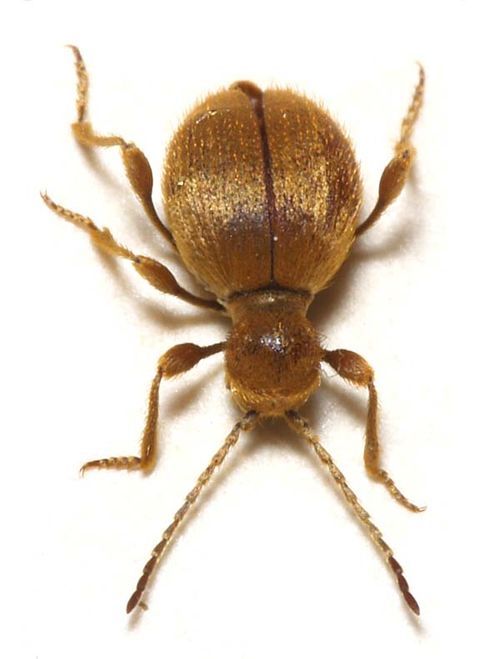
This evening i found this wee guy kicking about in the bathtub. We identified it as Niptus hololeucus, common name Golden Spider Beetle. Which may mean we have our first infestation! *high five*
N.hololeucus is from the order Coleoptera, meaning it's a beetle, and the family is Anobiidae, the same family that woodworm comes from.They are considered pests because they eat stored foods like cereals and fabrics, and are a major pest in natural history museums because they eat taxidermied specimens. Since we found it in the bathroom, away from the kitchen and our extensive stuffed animal collection, it's unlikely that we've got an infestation. These guys have no wings, which means it must have fallen into the bath from the air vent above.
Generally, N.hololeucus goes through several generations each year, and adults can live for up to 9 months. However, populations suffer great losses over harsh winters, like the one we're having now(the minimum temperature has been something silly like -15 at night), so it'll be interesting to see if we find any more.
I stole the image used here, but hopefully next time we'll get a picture of our subject :)
N.hololeucus is from the order Coleoptera, meaning it's a beetle, and the family is Anobiidae, the same family that woodworm comes from.They are considered pests because they eat stored foods like cereals and fabrics, and are a major pest in natural history museums because they eat taxidermied specimens. Since we found it in the bathroom, away from the kitchen and our extensive stuffed animal collection, it's unlikely that we've got an infestation. These guys have no wings, which means it must have fallen into the bath from the air vent above.
Generally, N.hololeucus goes through several generations each year, and adults can live for up to 9 months. However, populations suffer great losses over harsh winters, like the one we're having now(the minimum temperature has been something silly like -15 at night), so it'll be interesting to see if we find any more.
I stole the image used here, but hopefully next time we'll get a picture of our subject :)
Subscribe to:
Posts (Atom)